
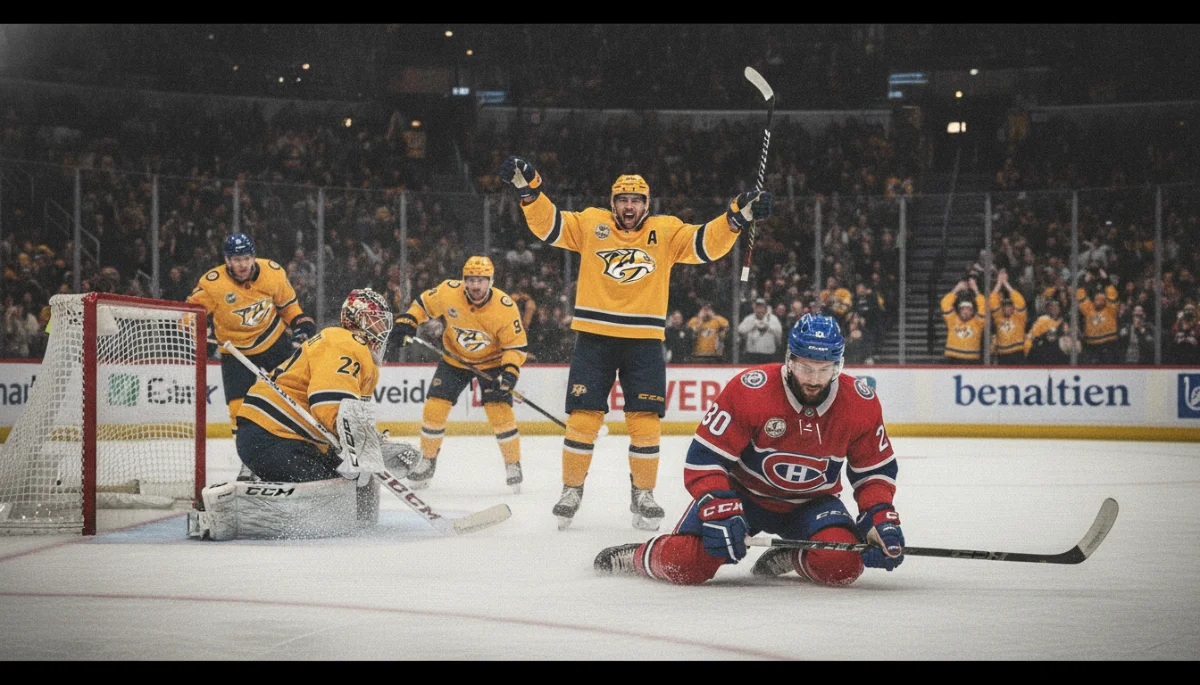
The Montreal Canadiens appeared to have Thursday’s game under control. They built a 2-0 advantage, created more pressure than the Nashville Predators and kept the Bell Centre energized.
By the final horn, however, Nashville had scored five consecutive goals and secured a 5-2 victory. Ryan O’Reilly’s late power-play goal completed the comeback, while two empty-net scores made the final margin look more decisive than the game itself.
The result extended Montreal’s winless run to three games and left the Canadiens with a 1-2-1 record. The defeat was less about being outplayed for 60 minutes and more about missed chances, untimely penalties and a failure to protect a two-goal lead.
Montreal Created the Better Start
For much of the first half of the game, Montreal dictated the pace. The Canadiens spent extended stretches in Nashville’s zone, moved the puck effectively and generated enough offensive activity to justify their early lead.
Nick Suzuki opened the scoring 3:12 into the second period during four-on-four play. He found a loose puck near the crease and finished the chance past Juuse Saros.
Alex Newhook then doubled the lead at 8:50. Josh Anderson set up the play after Montreal sustained pressure in the attacking zone, and Newhook converted to make it 2-0.
At that stage, the Canadiens had the game exactly where they wanted it. Nashville was struggling to create sustained offense, while the home team looked capable of adding another goal.
The problem was that Montreal never delivered that third goal.
Missed Chances Kept Nashville Alive
Montreal’s control did not translate into enough separation. The Canadiens generated quality looks, but Saros repeatedly denied them and prevented the deficit from becoming too large.
The Nashville goaltender finished with 32 saves, including several stops that preserved a one- or two-goal game. His performance allowed the Predators to remain within reach even while Montreal controlled possession and territorial play.
That became critical once Nashville found its first goal. Instead of chasing a multi-goal deficit, the Predators suddenly had a realistic path back into the contest.
Josh Anderson later had Montreal’s clearest opportunity to regain the lead. He broke in alone with roughly eight minutes remaining in regulation, but Saros turned the chance aside with his left pad.
A successful finish would have put Montreal ahead 3-2 and possibly changed the entire outcome. Instead, Nashville survived the threat, earned a power play soon afterward and took control of the ending.
Two Late Second-Period Goals Changed the Mood
The game shifted rapidly during the closing minutes of the second period.
Alexander Kerfoot cut the Canadiens’ lead to 2-1 with 4:54 left in the period. He redirected a point shot past Jacob Fowler, giving Nashville its first significant opening of the night.
Montreal still had a chance to regroup with a one-goal lead, but that advantage disappeared before intermission. Matthew Wood tied the game on a power play with only 32 seconds remaining in the period.
The timing was especially damaging. Montreal had spent much of the game in control, yet entered the third period level with a Predators team that had gained confidence.
Those two goals also exposed the danger of failing to capitalize during dominant stretches. A team can control the puck for long periods, but one defensive mistake or penalty can quickly erase that work.
Special Teams Decided the Final Minutes
Nashville’s power play became the difference in a game where five-on-five play often favored Montreal.
- The Predators scored the tying goal with the man advantage late in the second period.
- Mike Matheson was called for tripping Steven Stamkos late in the third.
- Ryan O’Reilly converted Nashville’s late power play with 3:16 remaining.
- Montreal did not produce a comparable special-teams response.
O’Reilly redirected Roman Josi’s point shot past Fowler to give Nashville its first lead of the night. The goal came after Montreal had failed to clear the danger created by Matheson’s penalty.
Close games often turn on a single special-teams sequence. In this case, Nashville made its opportunity count, while Montreal gave the Predators the opening they needed.
The Canadiens will need to be more disciplined against Detroit. Taking avoidable penalties late in a tied game is particularly costly when the opponent has strong shooters and traffic around the net.
Fowler’s Debut Was Not the Main Problem
Jacob Fowler made his first start of the season after being recalled from the Laval Rocket. Samuel Montembeault had suffered a lower-body injury during Wednesday’s practice, leaving Montreal to turn to its young goaltender on short notice.
Fowler stopped 15 shots, and the raw 5-2 score does not fully reflect his performance. Nashville scored three goals while he was in the net, then added two empty-net goals after Montreal pulled him late.
The 21-year-old faced difficult circumstances, including penalty kills and heavy traffic on Nashville’s power-play chances. The deflection on O’Reilly’s winning goal also gave him little opportunity to make a conventional save.
That does not mean Fowler was flawless. Like any goaltender after a loss, he will want certain plays back. Still, Montreal’s larger problems came from the team in front of him.
The Canadiens failed to finish their offensive chances, allowed Nashville to build momentum and committed penalties at critical moments. Those issues carried more weight than Fowler’s first-start performance.
Montembeault’s Absence Adds Pressure
Montreal’s goaltending situation is now worth monitoring closely. There was no clear timetable for Montembeault’s return at the time of Thursday’s game, so Fowler could be asked to handle another important start sooner than expected.
Fowler does have previous NHL experience. Last season, he appeared in 17 games and recorded a 9-6-2 record, a 2.43 goals-against average and a .908 save percentage.
That background should help, but the Canadiens still need to make his job easier. Better defensive positioning, cleaner penalty killing and stronger rebound control would reduce the pressure on whichever goaltender starts.
The 5-2 Score Hides a Competitive Game
Nashville’s two empty-net goals came from Adam Edstrom during the final minutes. Without those scores, this was a one-goal game decided late rather than a comfortable Predators win.
Montreal was not overwhelmed from start to finish. The Canadiens outplayed Nashville for long stretches and created enough opportunities to win. Their failure was in converting that advantage into a result.
The loss therefore offers a clear lesson rather than a reason for immediate panic:
- A 2-0 lead must become a larger advantage when chances are available.
- Strong possession is not enough without finishing around the net.
- Late penalties can erase an otherwise effective performance.
- Important third-period chances must be buried.
- Defensive structure has to remain reliable when protecting a tie.
Montreal’s power play also needed more impact. Nashville scored twice with the man advantage, including both the tying goal and O’Reilly’s winner, while the Canadiens could not produce a similar breakthrough.
Suzuki Remains a Key Positive
Nick Suzuki provided one of the night’s brighter moments by scoring Montreal’s opening goal. The captain now has three goals early in the season, and his ability to attack the area around the crease remains essential to the Canadiens’ offense.
Montreal will need Suzuki to continue leading while injuries and lineup changes create additional challenges. His production is especially valuable when the team must turn strong territorial play into actual goals.
Detroit Provides an Immediate Test
The Canadiens will not have much time to dwell on the collapse. The Detroit Red Wings are scheduled to visit the Bell Centre on Saturday, giving Montreal a quick opportunity to respond.
The priorities are straightforward. Montreal must finish more efficiently, avoid unnecessary penalties and provide dependable defensive support for its goaltender.
A 1-2-1 record and three-game winless streak are frustrating, but the season remains in its early stages. The more meaningful question is whether Montreal can learn from a game it was capable of winning.
Against Nashville, the Canadiens generated enough pressure to succeed. They simply did not execute when the game demanded it. Saturday’s matchup will show whether Montreal can turn a strong performance into a complete one.